David Ellison made a bold pronouncement last week when he told reporters that the new Skydance — that is, the combined Paramount-Warner Bros. Discovery — would spend more on content and storytelling than any other company in the world. |
The new behemoth will produce at least 30 films a year, required by a settlement with 12 state attorneys general over antitrust claims, as well as nearly 190 TV shows between the two studios. In total, the company has said it would spend at least $30 billion a year on film, TV and video game content. |
During a news conference last week, Ellison described Skydance as a company that “can now compete with anybody in the industry.” |
“When you look at what these assets are together, I genuinely believe it is the most powerful general entertainment library in the world,” he said. “We can go toe to toe with anybody in streaming. We have the capability to transform this business into the most technologically capable media company, to be the No. 1 destination for talent and to be able to operate efficiently. And we do believe that we’re in a position where we can lead in the industry.” |
Just about a week into this merger, there are still a lot of questions about what, exactly, this is going to mean for the industry. A lot will play out in the months ahead, but in speaking with industry analysts, a few major points have emerged. |
First, to address the elephant in the room — the new company’s debt load. |
Many of the possible scenarios from this merger are going to depend on how Skydance manages the $80 billion-plus debt it now carries. The company has already said it will make $6 billion in cost cuts over three years, and Ellison said last week that those “synergies” will not “primarily” come from labor, but instead from tech, procurement and “real estate optimalization.” |
One thing the company can’t cut is content spending. Movies and TV shows are going to be crucial for its streaming businesses, which will eventually merge together. Moreover, Ellison must prove to his skeptics that he’s serious about his production commitments, something he acknowledged last week, saying it was a “turbulent road” to get the merger finalized. |
If Skydance increases spending on content, that could push its competitors to also invest more, Laurent Yoon, senior analyst at the research and brokerage firm Bernstein, told me. |
“We are anticipating another round of increasing spend on content, whether that comes in the form of short-form micro-dramas or movies,” he said. “Each company will have their own strategies. All that requires investments.” |
What the company spends on is still an open question. Ellison’s companies have traditionally leaned toward blockbuster fare, though he said last week that Ryan Coogler’s “Sinners” was his favorite movie last year, and that originals would be part of the combined company’s film lineups, along with franchise development. |
But with such a heavy debt load, the company might want to focus most of its firepower on sure bets, said Brent Penter, research analyst at the financial services firm Raymond James. |
“I think you see them leaning more into those tentpoles and less into more experimental or riskier or unknown IP,” he told me. “I think they focus on the really high-value stuff.” |
It’s probably too soon to tell whether that could mean those kinds of riskier projects look elsewhere for distribution or development opportunities. In the last few years, Warner Bros. took several bets on original, auteur-driven fare, with some successes (Zach Cregger’s “Weapons,” and “Sinners”) and notable misses (“Digger,” “The Bride!”). |
But the sheer volume of franchises that Skydance now controls — including “Harry Potter” and “Lord of the Rings,” as well as “Transformers,” “Spongebob” and “Star Trek” — could mean other studios look to bulk up their own intellectual property to build scale, Penter said. |
Sports rights are another area of interest. Ellison knows the value of sports rights; after all, one of his first announced deals after he bought Paramount was a $7.7-billion deal for UFC streaming and TV rights. That’s probably still part of the equation to stay competitive in this industry, analysts said. |
“They have a big talent pool, they have great assets and scale,” said Jessica Reif Ehrlich, senior media and entertainment analyst at Bank of America Securities. “But it all depends on execution. If they execute well, this is going to have major industry ramifications.” |
Stuff We Wrote |
|
|
|
|
|
|
|
|
|
|
|
|
|
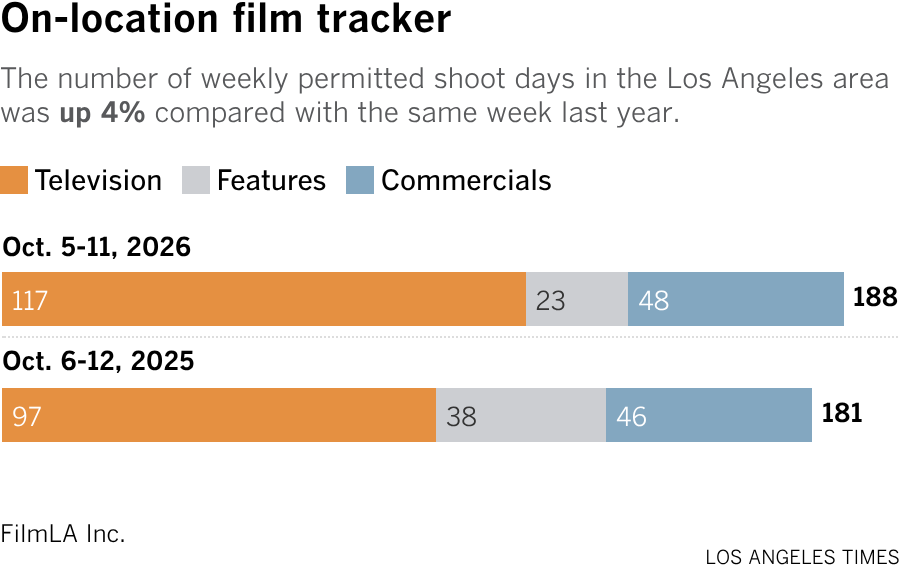
Film shoots |
 |
|
|
Number of the week |
 |
The box office difficulties for “Digger” continue to mount as the film saw a 60% drop-off at the domestic box office in its second weekend in theaters. |
The film, which stars Tom Cruise as an aging oil tycoon, has now made just $14.4 million in the U.S. and Canada. Worldwide, its total is $35.3 million. |
That’s a problem for “Digger,” whose production budget was reported at $125 million, though some industry experts have said it could be closer to $160 million due to production delays. With that kind of budget, the studio could be poised for a big loss, to the tune of at least $150 million. |
Keep up with California |
Your support helps us deliver the news that matters most. Subscribe to the Los Angeles Times.
|
|
|
|
|
|
What I’m watching |
I love a period drama, so I’ve been watching Netflix’s adaptation of “East of Eden,” which stars Florence Pugh. I’ve never been a huge John Steinbeck fan, but I may give the book a chance after this sumptuous reimagining of the novel. |





No comments:
Post a Comment