I’ve always been a chaotic, disorganized cook. If I’m not careful, even the simplest meals can leave my kitchen looking like a disaster zone. |
But one day, about six years ago, I learned a lesson that has helped me temper my more frenetic tendencies. |
I was in Oakland, helping my friend Caleb Peyton — a former Chez Panisse cook — pick parsley for a catering event. The task was taking me a long time, and I was making a mess, sorting through tangles of half-picked stems mixed in with picked leaves and untouched sprigs. I was flustered. |
Noticing my struggles, Caleb came over and gently asked if he could show me a better way to do it. |
Quickly, he rearranged the space in front of me and began explaining his process as he made quick work of the herbs. |
|
|
“The unpicked parsley is in its produce bag on your left, the discard bowl for stems is in the middle, and a bowl for the final picked leaves is on your right. You grab one sprig of parsley with your left hand, pull all the leaves off in one motion with your right hand, drop the stem into its bowl and the leaves into their bowl. No wasted movements.” |
No wasted movements. |
Caleb wasn’t just teaching me how to pick parsley. He was demonstrating an invaluable cooking principle: economy of motion. |
To me, economy of motion means doing every task efficiently, with the least possible amount of wasted time and energy. |
Not only can it be applied to every single cooking task you do — from peeling carrots to forming meatballs — but without it, a restaurant’s cooks could never keep up with the massive volume of food they need to prepare. |
|
|
When I first started at Chez Panisse, I wasted a lot of time. |
It took about two minutes of fast walking to get from the prep kitchen to the walk-in refrigerator where the produce was stored. Not knowing any better, I’d take that trip every time I needed a different ingredient. It probably cost me about 20,000 steps and who knows how many minutes a day. |
As I became more experienced (and after many days of being embarrassingly behind on my prep), I also became more thoughtful and organized. |
At the beginning of each shift, I’d write two lists — “to gather” and “to do” — with every single piece of equipment and ingredient I’d need that day. Then, I’d make as few trips as possible to get everything I needed, piling pounds of broccoli and boxes of mushrooms into bus tubs and hauling them up the stairs to the line. |
Every day at Chez was an opportunity to improve my efficiency. |
Keep up with California |
Your support helps us deliver the news that matters most. Subscribe to the Los Angeles Times.
|
|
|
|
|
|
One day on the pizza station, I was preparing three pizzas at once. Another cook, Raja, noticed me repeatedly reaching for small handfuls of the same topping, each time just enough for just one pizza. He encouraged me instead to just reach once per topping, grabbing a huge handful at a time and scattering them on all my pizzas before returning any extras to their container. |
It might seem small, but this move saved me one return trip to and from the container for each pizza. Repeat that across 60 pizzas in a night, and it starts to add up. |
You might be wondering why this is important at home, where you’ll often be cooking on a much smaller scale. |
Let’s say you’re dicing six onions for soup. Your instinct might be to process one onion, all the way through, six times over. Done that way, you might: Grab your knife; take off any protruding roots and the stem end; cut it in half; put down your knife; peel the onion; grab the peel, stem and root; throw them away; grab your knife again; slice it lengthwise; slice it hamburger style; dice it crosswise; put down your knife; scoop up the onion and put it into a bowl; pick up your knife again; and start the whole thing over again. |
Doesn’t sound that fun, does it? |
Instead, consider this: Root, stem and cut each of your onions in half. Put your knife down, clean your board, and grab your knife. Cut them all lengthwise and then hamburger style. Then, dice each onion. Put your knife down, scoop up all the onion and transfer it to a bowl. |
Sounds better, right? |
To practice economy of motion, it’s important to examine each task before you get started and to think about how you can do it most efficiently. |
That might mean setting up little assembly lines for yourself, something like Caleb showed me with the parsley: unprepped ingredient -> discard pile -> prepped ingredient. |
Assembly lines — a neat breading station, for example, with a plate of your raw chicken cutlets on one side, then next to it flour, then egg, then breadcrumbs and finally a plate to land the finished specimens on — allow you to turn into a uni-purpose, efficient machine. |
The beauty of refining the efficiency in your cooking is not only that it helps you stay organized — so you (I) don’t work yourself into a chaotic frenzy and, say, knock over a whole open jug of olive oil — but also that it opens up brain space and allows you to be more creative and present. |
As you set into the rhythm of whatever repeated motion you’re doing, you can refine how well you’re doing it, start thinking about your next steps or dream up an additional component to whatever you’re making. |
Automate the tedious tasks, and you can focus on the fun parts of cooking. |
Eventually, you might start to notice the economy of motion creeping into other parts of your life, too. Perhaps after you put the kettle on the stove, you’ll use the time it takes to boil to brush your teeth. Maybe you’ll find a faster way to put away your laundry. Who knows! |
If you aren’t ready to brush your teeth or do your laundry, watch this week’s video and try putting this lesson into practice with the recipes below. See you next week. |
Happy eating,
Cody |
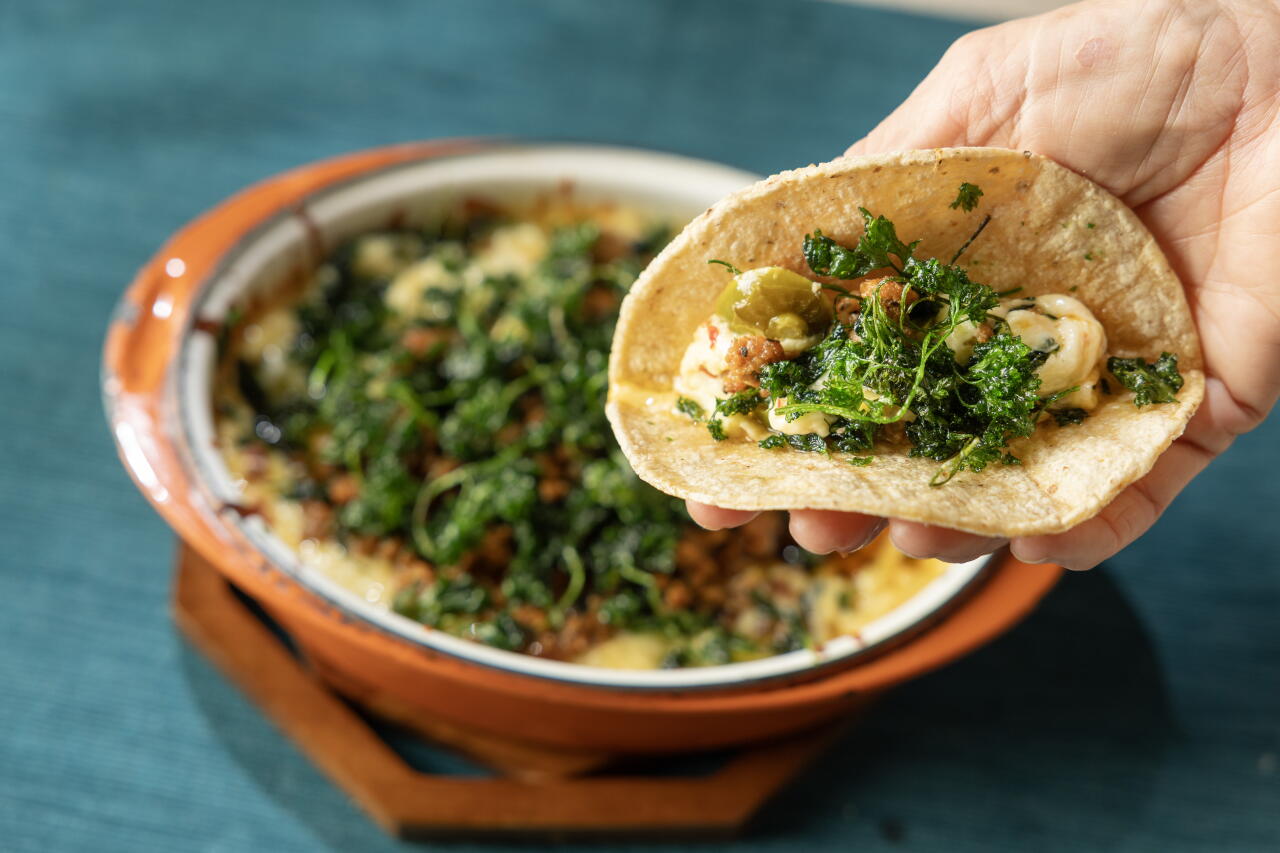
An Extra-Cheesy Dip With Chorizo And Crispy Parsley |
Put your parsley picking skills to the test with this cheesy, comforting dip.
Get the recipe.
Cook time: 20 minutes. Serves 8. |
 |
(Myung J. Chun/Los Angeles Times) |
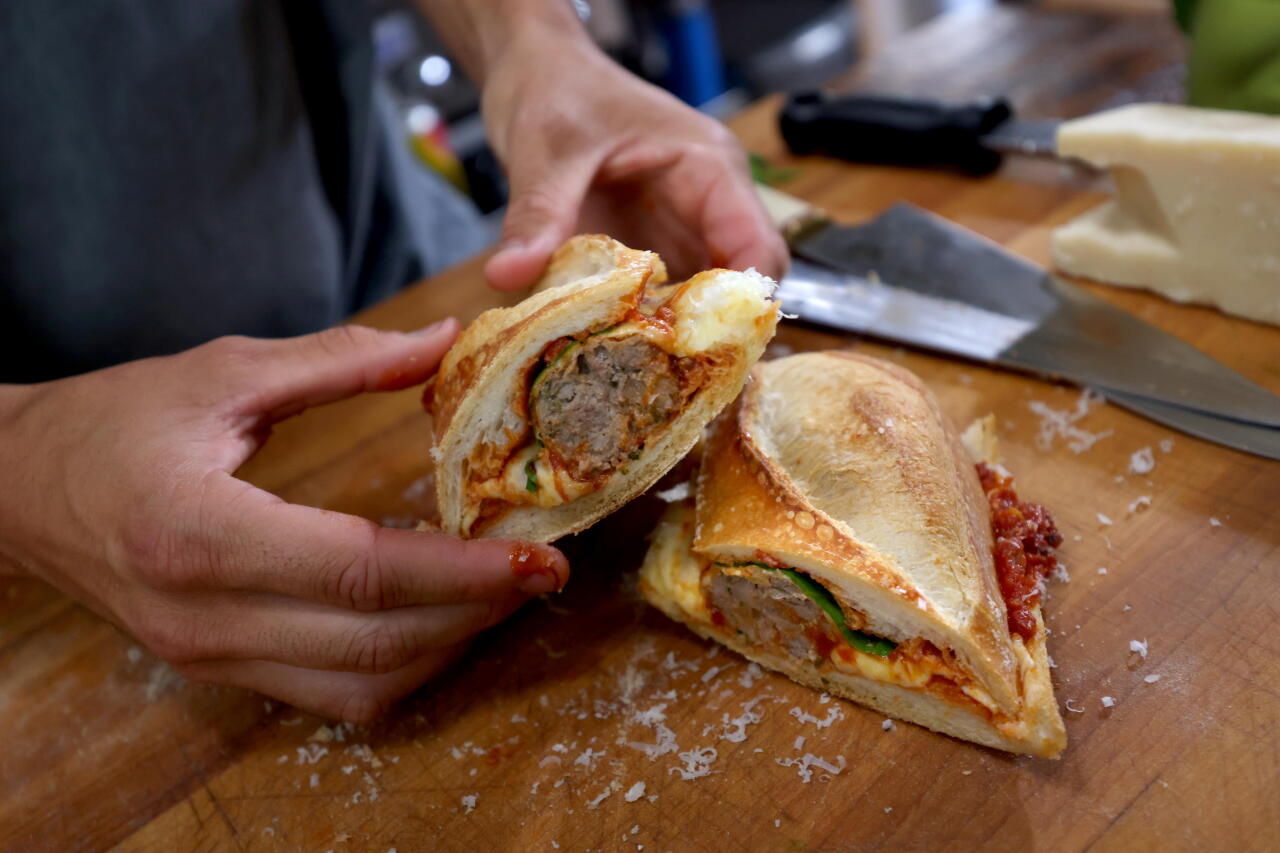
Nonna’s Meatball Sandwich |
Making meatballs at home can be a messy, overwhelming task. Try to put your economy-of-motion hat on and organize each step of the process in a way that’s organized and tidy.
Get the recipe.
Cook time: 3 hours. Serves 4. |
 |
(Genaro Molina/Los Angeles Times) |





No comments:
Post a Comment