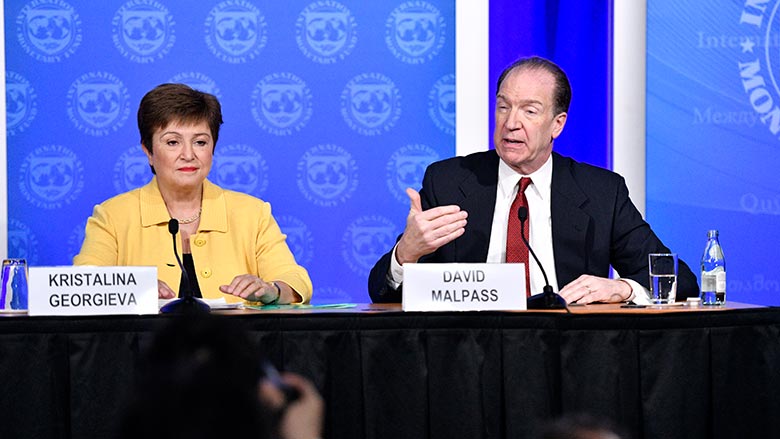
| The World Bank Group and the International Monetary Fund urge official bilateral creditors to provide immediate debt relief to the poorest countries facing COVID-19. Read the statement. Go deeper: Learn how the World Bank Group is responding to the COVID-19 (coronavirus) pandemic. Explore our multilingual portal. Click, bookmark and come back for update. Today: World Bank Group President David malpass joined the G20 Virtual Leaders Summit this morning to highlight ongoing World Bank Group efforts to respond to the COVID-19 pandemic. During the summit, he reiterated his call for debt relief for poor nations. "We have new COVID-related projects underway in 56 countries and we're encouraging other MDBs to co-finance follow-up tranches," said Malpass. "In 24 countries, we're restructuring existing projects in order to direct funds to the health emergency." He added that private sector support is critical. "IFC, our private sector arm, is already working on new investments in 300 companies and extending trade finance and working capital lines to clients." Read his full remarks here. End of Week Update: Over the past week, the crisis related to COVID-19 has continued to worsen. Here is World Bank Group President David Malpass' summary of some of the Bank Group's activities in response. COVID-19 Challenges and Response: The World Bank Group is committed to providing a fast, flexible response to the coronavirus pandemic. We are offering financing, policy advice and technical assistance in every region, across every area from healthcare and education to trade and technology. In this blog series we explore how different teams around the World Bank Group are responding to the challenges ahead. The first in our series comes from Latin America and the Caribbean. World Bank teams are in touch with member countries in the region to address any requests for assistance and offer technical support as needed. Snapshot: Could people working in tourism be redeployed to help health services respond to COVID19? That's just one idea to help the industry recovery quickly from the impact of the pandemic. School closed? In China, a massive effort is underway to make sure children keep learning. Technology seems to be the answer. We will only know how effective this is after the crisis, but it does seem to be a good use of children's time. Large-scale, national efforts to utilize technology in support of remote learning, distance education and online learning during the COVID-19 pandemic are emerging and evolving quickly. On this page, we've curated useful resources by the World Bank's EdTech team in support of national dialogues with policymakers around the world. This map shows the status of school status across the globe. Lessons Learned: Korea offers a model for other countries battling COVID-19, as noted recently by the World Health Organization. Applying lessons learned from the MERS outbreak in 2015, Korea has been strengthening its infectious disease surveillance and response capacity. Listen: As the COVID-19 pandemic rapidly spreads across the globe, we hear from the World Bank Group's Global Director for Health, Nutrition, and Population, Dr. Muhammed Pate, about an emergency support package the Bank has announced – valued at up to $14bn – to help countries preparing for or responding to the outbreak. And as always, we bring you the data driving this story. Listen to the podcast here. | 





No comments:
Post a Comment